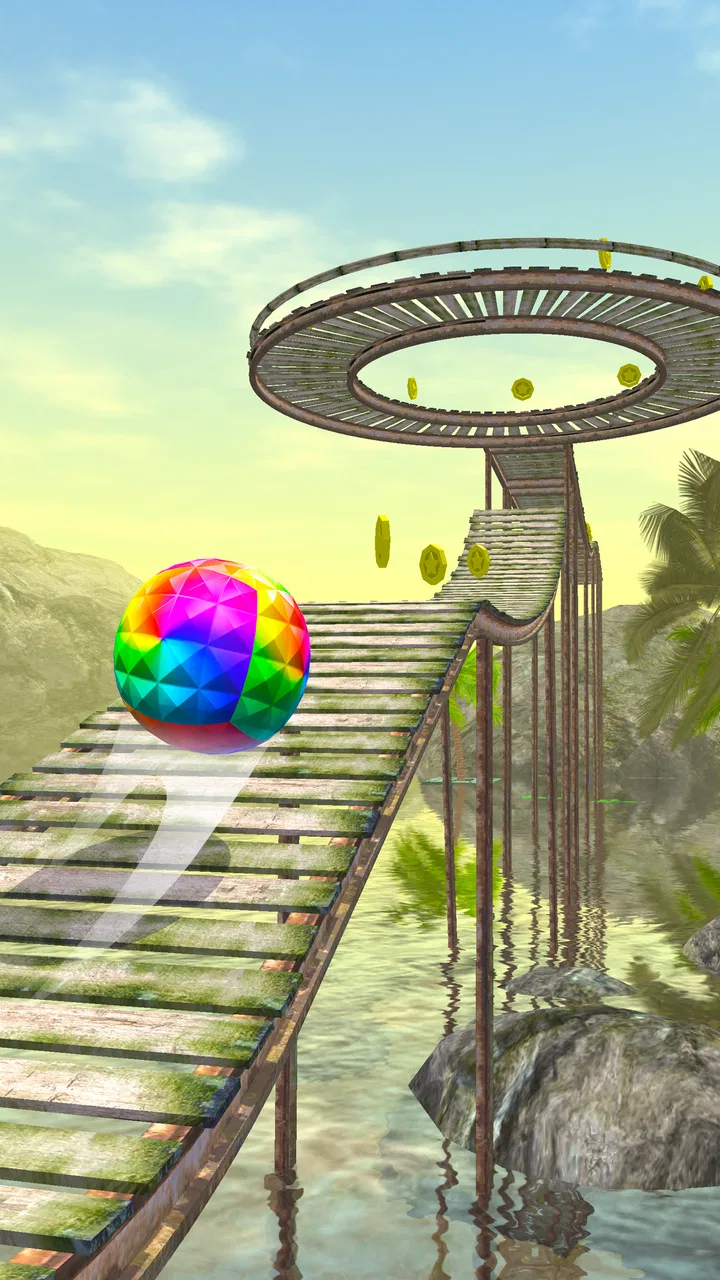
Rollance : Adventure Balls
- 4.0
- Rating
- 100.00M
- Installs
- Free
- Price

 Analysis by App-foxy
I spent time with Rollance: Adventure Balls as a quick-action game built around one simple challenge: keeping a ball moving without sending it off the course. That idea sounds modest, but it creates a surprisingly tense rhythm. I was usually making small steering decisions, watching the path ahead, and trying to recover when the ball started drifting toward an edge. It is the kind of game I can open for a short break, yet it still gives me a reason to replay a section when a mistake feels avoidable.
Developed by CASUAL AZUR GAMES, this free action game is aimed at Everyone and runs on Android devices using version 6.0 or later. Its broad audience makes sense because the basic objective is immediately understandable, while the challenge comes from control and timing rather than complicated instructions. The game has reached over 100 million installs, with a 4.1 average from around 79 thousand ratings, so it clearly appeals to a large casual audience. Still, popularity does not automatically make it right for every player, especially if you want a deep story, long-term character development, or a more traditional action experience.
Rolling, steering, and learning the course
The central appeal is the feeling of guiding something unstable. A ball does not stop instantly, and that gives every movement a little consequence. I found myself thinking less about dramatic attacks and more about positioning: where the next turn begins, how much room remains beside the path, and whether correcting too sharply would create a worse problem. That makes the game feel closer to a reflex and balance exercise than to a conventional combat-focused action title.
You May Also Like

 Blood Strike: 2.5 Anniversary
Blood Strike’s Loadouts Turn Every Drop Into a Tactical Gamble
A close look at Blood Strike’s custom loadouts: how fast access to signature weapons reshapes its battle royale rhythm, rewards preparation, and narrows the gap between fights.

 Pandora - Music & Podcasts
Pandora’s Music Is Easy to Start, but Harder to Recover
Pandora’s strength is its low-effort path from a seed to a station. Its weak spot is how much confidence it asks you to place in connection, setup, and quiet recovery.

 8 Ball Pool
 Is Built on Rivalries, Rematches, and Routine
A close look at the rivalries, rematches, shared routines, and unanswered safety questions that turn a quick pool match into a persistent mobile community.

 Samsung Music
’s Quiet Strength Is Playing What You Already Own
Its reach comes less from spectacle than from dependable access to a personal library. That simplicity is both the app’s strongest retention engine and its ceiling.

 AccuWeather: Weather Radar
AccuWeather Review: A Quick, Clear Forecast for Everyday Decisions
For everyday plans, the best forecast is the one you can understand quickly. AccuWeather makes rain timing, radar, and local conditions easy to act on, with a few trade-offs.

 Hill Climb Racing
Why Hill Climb Racing Still Turns Crashes Into One More Run
A tiny car, a bumpy hill and one more upgrade: Hill Climb Racing keeps resurfacing because its simple chaos makes every near-miss feel personal.
More From Our News Desk



The best way to approach a new section is to treat the first attempt as information gathering rather than a serious score run. I watch the shape of the route, identify narrow areas, and notice where momentum becomes difficult to manage. This small change in attitude makes failure less irritating. Instead of feeling that the game simply caught me out, I can usually identify the decision that caused the fall and adjust it on the next pass.
One useful habit is to avoid constant overcorrection. When the ball begins moving away from the ideal line, my first instinct is often to make a large adjustment. That can turn a manageable drift into a sudden slide. Smaller inputs give me more time to react, particularly when the route changes direction quickly. The game rewards patience more than frantic movement, even though the action itself looks fast.
I also recommend looking farther ahead than the immediate section. A turn that appears safe on its own may leave the ball poorly positioned for the next change in direction. Thinking one obstacle ahead helps me choose a better line and reduces the need for emergency steering. This is one of the more interesting details of the experience: the controls may be approachable, but consistent success depends on planning rather than simply reacting.
A good fit for short sessions
Rollance works particularly well when I have only a few minutes. I can start a run without committing to a long narrative sequence or a complicated setup. That makes it useful during a commute, while waiting for an appointment, or between larger tasks at home. The action is easy to understand even when I have not played recently, so I do not need a lengthy refresher before trying again.
That convenience also exposes one of its limitations. Because the basic loop is focused on movement and avoiding falls, players who need a strong story or a constantly changing set of mechanics may find the experience repetitive. The satisfaction comes from improving control and reaching farther, not from discovering a complex world or building a detailed team. I would not choose it as my main action game if I wanted substantial progression or a cinematic campaign.
The Everyone rating makes it approachable for families and younger players, although the difficulty can still create frustration. A child who enjoys repeating a challenge and improving through practice may find it rewarding. Someone looking for immediate success may lose interest after a few falls. I would introduce it as a game about careful movement, not as a completely effortless pastime.
What the free download means in practice
The game is free to download, which makes trying it straightforward. I can see whether the rolling controls suit me without paying an entry fee. That matters here because the entire experience depends on whether I enjoy this specific style of movement. If the first sessions feel satisfying, the free access gives the game a reasonable chance to earn a place in my regular rotation.
There are in-app purchases priced at $1.99 per item. I would therefore treat the free version as the starting point and consider purchases optional rather than part of the basic decision to install. The important value question is not whether the game can be downloaded without charge; it is whether the core play remains enjoyable enough that any optional spending would feel worthwhile. I would not spend simply because a difficult section made me impatient.
That distinction is useful for families. Since the game is suitable for Everyone but includes purchases, I would check the device’s purchase controls before handing it to a child. The game itself may be easy to understand, yet an adult should still decide whether optional items fit the household’s rules. For my own use, the sensible approach is to play first, learn how much content and replay value I actually receive, and only then decide whether a purchase adds meaningful convenience.
The current version is 0.14.80, and the game was released on August 15, 2022. I mention those details because they help identify the edition a reader is considering, not because they change the basic recommendation. The main question remains whether a physics-like rolling challenge is entertaining enough for repeated attempts. A newer version number does not turn a compact arcade loop into a different genre.
Where the value comes from
For me, the strongest value is in the gradual improvement of control. A successful run feels earned when I have learned how the ball responds and stopped making unnecessary corrections. That gives the game a practical kind of replay value: I return not only to reach a destination, but to see whether I can handle the same style of situation more cleanly.
It can also work as a low-pressure way to sharpen attention. I need to divide my focus between the ball’s current position and the route that is about to arrive. A short session can feel mentally active without requiring the emotional investment of a competitive multiplayer match. I would not describe it as a training tool, but it does encourage visual scanning, timing, and restraint.
Another strength is how clearly the game communicates its main risk. Falling is not an abstract penalty hidden behind complicated systems; it is the direct result of losing control of the route. That makes mistakes readable. When I fail, I can usually ask whether I turned too late, moved too far, or ignored the next section. This clarity is valuable for players who like games where improvement comes from their own decisions.
The trade-off is that the same focus can narrow the experience. If the rolling challenge does not click, there may not be another major layer to pull me back in. Traditional platform games often offer jumping, enemies, collectibles, or exploration to break up movement. A runner may provide a stronger sense of speed and automatic flow. Rollance sits in a more controlled middle ground, where the main pleasure comes from guiding the ball accurately.
Everyday use and practical play habits
Imagine having ten minutes before leaving for work. I can play a few attempts, notice one mistake, and stop without feeling that I abandoned a complicated mission. Later, I can return with a specific goal: keep a steadier line through the turn that caused trouble. That kind of small, personal target makes the game more satisfying than simply trying to play as quickly as possible.
For a calmer session, I would avoid multitasking. The controls may look simple, but a conversation, video, or busy environment can make small steering errors more likely. If I am playing while tired, I also expect my performance to drop because the game depends on attention rather than button combinations. The best short sessions are focused ones, even when they last only a few minutes.
A second useful approach is to separate experimentation from progress. On an early attempt, I may deliberately take a safer line to understand how much room I have. Once I know the route, I can try a more direct path. This prevents me from confusing unfamiliarity with poor controls. It also gives the game a little more depth than the short store summary suggests, because route choice becomes part of the learning process.
I would also avoid judging the game after one frustrating run. Rolling games can feel awkward before the player develops a sense of momentum. At the same time, I would not force myself to continue indefinitely. If repeated attempts feel like correcting the same movement without any satisfaction, that is a sign the design may not match my preferences. Free access makes this trial-and-stop approach easy.
Who should play it, and who should look elsewhere
I think the game is a good match for people who enjoy compact action challenges, precision movement, and retrying a section to improve. It suits players who like seeing a mistake, understanding it, and attempting a cleaner run. It is also a reasonable choice for someone who wants a free game that can fit around a busy day rather than demand a long uninterrupted session.
It may be especially appealing to fans of obstacle courses and balance-based gameplay. The ball gives the experience a different feel from a character who can stop, jump, or attack on command. That difference is important: success depends on guiding motion, not simply selecting the right action at the right time. Players who enjoy learning a game’s physical behavior may get more from it than players who want constant spectacle.
I would suggest skipping it if your priority is a rich narrative, role-playing progression, direct combat, or cooperative play. I would also be cautious if falling and repeating a route quickly becomes annoying. In those cases, a platformer with more varied abilities or a runner focused on speed may offer better value for your time. Rollance is not trying to replace those games; its appeal is narrower and more focused.
The game can also be a poor fit for anyone who wants a completely passive distraction. Although it is easy to start, the rolling challenge asks for regular attention. I cannot reliably play it while watching something else and expect consistent results. That is a strength when I want a small concentration exercise, but a weakness when I only want background entertainment.
My buy-or-skip verdict
I would recommend downloading it if you are curious about careful ball control and want a free action game for short, repeatable sessions. The absence of an upfront price lowers the risk of trying it, while the Everyone rating makes its intended audience broad. Its best moments come when a route that once seemed awkward becomes manageable because I changed my timing or stopped oversteering.
I would keep spending conservative. The optional items cost $1.99 each, so I would only consider one after deciding that the basic game already gives me enough enjoyment to justify further support. I would not treat a purchase as a solution to impatience or as a substitute for learning the controls. The strongest value is already tied to practice, observation, and replaying with a better plan.
My honest conclusion is that Rollance: Adventure Balls is a focused, accessible choice rather than a broad action package. It delivers a clear challenge, works well in brief sessions, and offers satisfying improvement for players who enjoy precision. Its narrow loop and potential repetition will not suit everyone, and players seeking story or combat should choose another type of game. For me, it earns a recommendation as a free download to test, with one important condition: you should enjoy the act of controlling a rolling ball, because that is where nearly all of the game’s value lives.
FAQs for Rollance : Adventure Balls
01What is the main objective of Rollance: Adventure Balls?
Rollance: Adventure Balls is an action-packed puzzle game where players navigate a variety of challenging levels. The main objective is to guide a rolling ball through intricate mazes, avoiding obstacles, and collecting rewards. Each level presents unique challenges that require strategic thinking and precision steering to complete.
02How are the controls in Rollance: Adventure Balls?
The game features intuitive touch controls that allow players to easily maneuver their ball through each level. By swiping on the screen, you can control the direction and speed of the ball, making it accessible for both beginners and experienced players. The controls are responsive, enhancing the overall gaming experience.
03Is Rollance: Adventure Balls suitable for all ages?
Yes, Rollance: Adventure Balls is designed to be family-friendly and suitable for players of all ages. Its colorful graphics, engaging gameplay, and simple controls make it an ideal choice for younger audiences, while the increasing difficulty levels keep older players entertained and challenged.
04Does Rollance: Adventure Balls support multiplayer mode?
Currently, Rollance: Adventure Balls focuses on single-player gameplay. While there is no multiplayer mode, players can compete with friends by comparing scores and achievements. The game encourages friendly competition through leaderboards, allowing players to see how they rank against others globally.
05Are there any in-app purchases in Rollance: Adventure Balls?
Rollance: Adventure Balls offers optional in-app purchases that enhance the gaming experience. Players can buy additional levels, power-ups, or cosmetic upgrades for their balls. However, these purchases are not necessary to enjoy the game, as all core levels and features are accessible without spending money.
Pros
- Engaging and vibrant graphics.
- Smooth and intuitive controls.
- Variety of challenging levels.
- Regular updates with new content.
- Multiplayer mode enhances fun.
Cons
- In-app purchases can be pricey.
- Occasional lag on older devices.
- Ads can interrupt gameplay.
- Limited customization options.
- Requires constant internet connection.

Rollance : Adventure Balls
Gallery